Harry Potter and the Methods of Rationality
Less wrong (Eliezer Yudkowsky) • Self Published • approx. 1000 pages

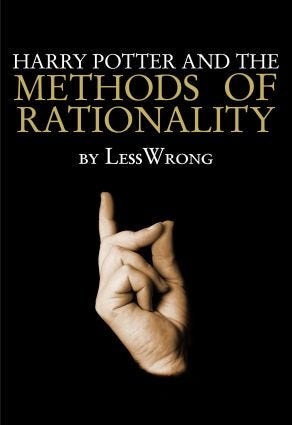
Themes: Fan fiction, Harry Potter, Rationality, Spoof, Scientific Method
Read this if: You’re still disappointed you didn’t attend Hogwarts.
Don’t read this if: You dislike sardonic narrators, or the Harry Potter franchise.
If you’ve read Harry Potter as many times as I have, during one of your read-throughs you may have stopped and pondered, what would happen if Voldemort stole a nuke? Does a shield charm protect against nuclear annihilation? If these questions spark your curiosity, then “Harry Potter and the Methods of Rationality” is worth your time.
The author, Eliezer Yudkowsky (pseudonym, less wrong) has set out to prove that edification need not be painful. He has ensconced an introductory seminar on the principles of rationality within the cloak of the Harry Potter universe creating a revelatory fan fiction. The book masterfully blends two seemingly incompatible subjects: magic, and the scientific method. The story has enough canonical passages from the original books sprinkled throughout for Harry Potter aficionados to bask in the warm glow of familiarity.
The book takes place in an alternate universe where, rather than marrying Vernon Dursley, Petunia Evans has married an Oxford biochemistry professor. Harry grows up a doted-on, scientific savant with a love for space travel and a sardonic disposition. The story unfolds over Harry’s first year at Hogwarts chronicling his attempts to explore his ‘mysterious dark side’, and to tame magic via scientific experimentation. The cast of characters will be familiar to any Harry Potter fan, while the relationships between them will scarcely be recognisable.
In the current world where it often feels like the search for objective truth has been collectively abandoned. I found Harry’s attempts to subject magic to the powers of reason to be way more heroic than the author likely intended. It could just be that this story is the unintended balm for anyone who feels like they’ve been scarred by the recent political environment.
Taking a canonical series such as Harry Potter, foundational to the psychology of an entire generation of readers, and reworking it to put your own stamp on it is a formidable challenge. JK Rowling herself wasn’t up to the task when she foisted The Cursed Child onto the reading public. That’s what makes “Harry Potter and the Methods of Rationality” (HPMOR) so impressive. Is it as good as the original series? Of course it’s not! But that also isn’t the point. The author has taken source material, and reworked it to make something that tells a new story, and teaches new lessons. That is a commendable achievement in its own right. The fact that the author writes with intelligence and comedic wit is an added bonus:
“It's only a Transfiguration," said Professor McGonagall. "An Animagus transformation, to be exact."
"You turned into a cat! A SMALL cat! You violated Conservation of Energy! That's not just an arbitrary rule, it's implied by the form of the quantum Hamiltonian! Rejecting it destroys unitarity and then you get FTL signalling! And cats are COMPLICATED! A human mind can't just visualise a whole cat's anatomy and, and all the cat biochemistry, and what about the neurology? How can you go on thinking using a cat-sized brain?"
Professor McGonagall's lips were twitching harder now. "Magic."
"Magic isn't enough to do that! You'd have to be a god!"
Professor McGonagall blinked. "That's the first time I've ever been called that."
A blur was coming over Harry's vision, as his brain started to comprehend what had just broken. The whole idea of a unified universe with mathematically regular laws, that was what had been flushed down the toilet; the whole notion of physics. Three thousand years of resolving big complicated things into smaller pieces, discovering that the music of the planets was the same tune as a falling apple, finding that the true laws were perfectly universal and had no exceptions anywhere and took the form of simple maths governing the smallest parts, not to mention that the mind was the brain and the brain was made of neurons, a brain was what a person was-
And then a woman turned into a cat, so much for all that.
The blurb gives a good look at what you can expect. This story is not for everybody. The alternate Harry (who I suspect is a facsimile of the author) is not nearly as likeable/relatable a Potter as the original we all know and love. His sardonic appraisals of the world around him will surely turn off some readers, as will the writing style if readers go into this with the expectation that the writing will be up to the Rowling standard. Keep in mind this is an amateur work!